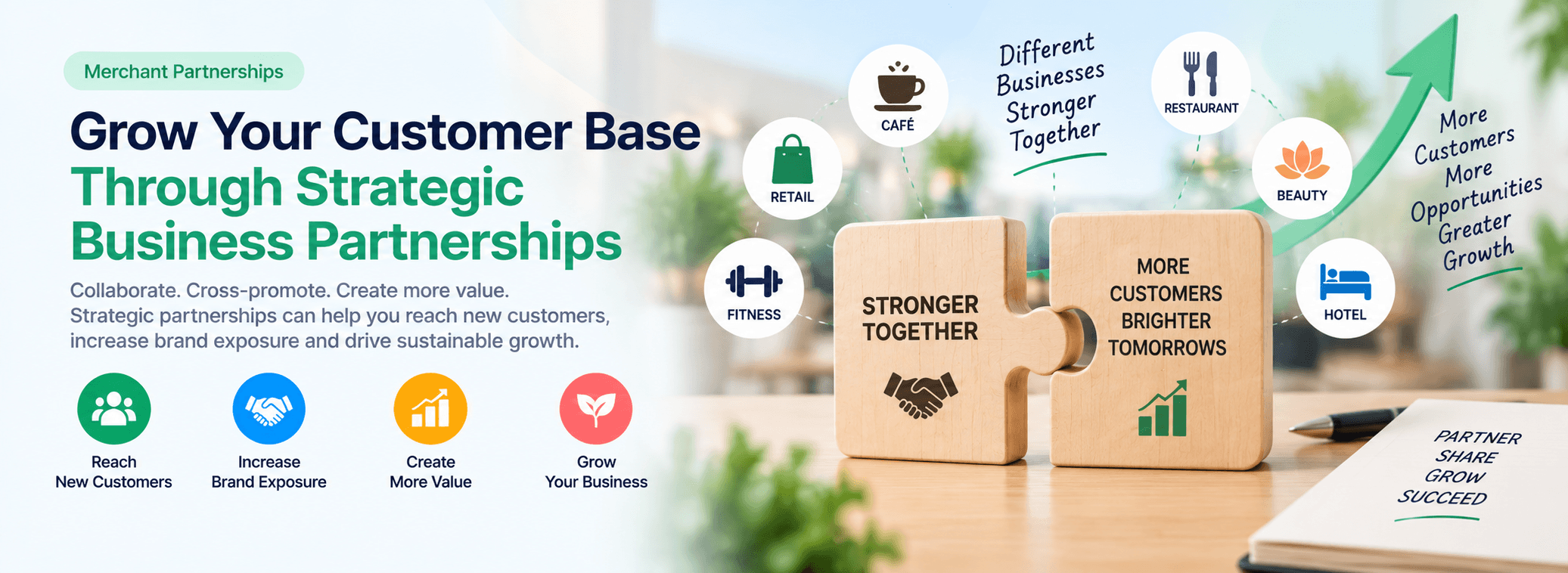
Growing a customer base is one of the biggest challenges businesses face. Advertising can help attract new customers, but acquiring customers through marketing alone can become increasingly expensive.
One way businesses can expand their reach is through strategic partnerships with other businesses. By working together, two or more businesses can introduce their products or services to new audiences while creating additional value for their existing customers.
A well-designed partnership can become more than a promotional arrangement. It can create a continuous customer acquisition channel that benefits everyone involved.
What Is a Business Partnership?
A business partnership is a collaboration between two or more businesses where each party contributes something valuable to achieve a shared objective.
The partnership could involve sharing customers, promotions, rewards, content, events or other resources.
For example, a restaurant could partner with a nearby fitness centre. The fitness centre can introduce its members to the restaurant, while the restaurant can provide exclusive offers to fitness centre members.
Both businesses gain access to a relevant audience that they may not have been able to reach as efficiently on their own.
The best partnerships create value for both businesses and their customers.
Instead of simply exchanging advertisements, businesses should look for ways to create a useful customer experience together.
Why Strategic Partnerships Can Help Grow Your Customer Base
Partnerships can help businesses grow by providing access to customers who already have an established relationship with another brand.
Instead of starting from zero, your business can leverage the trust and reach that your partner has already built.
Reach New Customers
Introduce your products or services to an audience that already matches your target customer profile.
Reduce Customer Acquisition Costs
Share marketing activities and resources instead of relying entirely on paid advertising.
Build Brand Awareness
Increase exposure by appearing in front of customers through another trusted business.
Create More Customer Value
Give customers access to complementary products, services, benefits or rewards.
Choose the Right Business Partners
Not every business is a suitable partner. A successful partnership starts by identifying businesses that have a complementary customer base.
Your partner does not necessarily need to sell the same product or service. In fact, complementary businesses can often create stronger partnerships because they provide something different to the same target audience.
When evaluating a potential partner, consider:
- Do they serve a similar target audience?
- Does their brand have a good reputation?
- Do their products or services complement yours?
- Can both businesses benefit from the partnership?
- Are they willing to actively promote the partnership?
- Can the partnership provide meaningful value to customers?
Create a Clear Partnership Offer
Once you identify a potential partner, the next step is to create an offer that is simple and attractive to customers.
Customers should immediately understand what they receive and why the partnership is valuable.
Examples include:
- Exclusive discounts for partner customers
- Special vouchers or rewards
- Cross-brand promotions
- Member-only benefits
- Bundle offers
- Referral rewards
- Joint events or campaigns
Make the customer benefit easy to understand.
The simpler the offer, the easier it is for customers to participate and for both businesses to promote it.
Use Loyalty Programs to Strengthen Partnerships
Business partnerships become even more powerful when they are connected to a customer loyalty program.
Instead of simply promoting another business, you can give your customers the opportunity to earn or redeem rewards across participating businesses.
For example, a customer who earns points from one merchant could use those points to redeem a reward from another participating merchant.
This creates a broader ecosystem where businesses can work together while customers receive more reasons to participate.
A Simple Partnership Growth Cycle
Connect with complementary businesses
Introduce the partnership to customers
Give customers relevant benefits
Acquire and retain more customers
Promote the Partnership Across Multiple Channels
A partnership will only create results if customers know about it. Both businesses should actively promote the collaboration through their existing marketing channels.
Depending on the partnership, promotion can include:
- Email campaigns
- Mobile app notifications
- Social media posts
- In-store promotions
- Website banners
- Customer loyalty platforms
- Events and joint campaigns
- Referral campaigns
Sharing promotional responsibilities also means both businesses can benefit from greater exposure without one company having to carry the entire marketing cost.
Track the Results
Like any marketing strategy, business partnerships should be measured.
Tracking performance helps you understand whether the partnership is generating meaningful results and whether it should be expanded, adjusted or replaced.
Useful metrics include:
New Customers
Measure how many new customers were acquired through the partnership.
Referral Activity
Track how many customers were referred by your partner.
Purchase Activity
Compare purchase frequency and spending before and after the campaign.
Customer Engagement
Measure voucher redemptions, reward activity, campaign participation and repeat visits.
Turn One Partnership Into a Business Network
A successful partnership does not have to remain a relationship between only two businesses.
Once the model has been proven, businesses can gradually build a larger network of complementary merchants.
For example, a customer ecosystem could connect restaurants, retailers, beauty businesses, fitness centres, entertainment providers and other local businesses.
Each participating business can introduce customers to other businesses while providing additional benefits through the network.
Benefits of a Connected Business Network
More Reach
Access customers from multiple businesses within the network.
More Value
Provide customers with more rewards, offers and experiences.
More Opportunities
Create new cross-promotional and customer acquisition opportunities.
Build Partnerships Around Customer Value
The strongest partnerships are not built simply because two businesses want more customers. They succeed because the collaboration creates something useful for the customer.
Before launching a partnership, ask:
Does this partnership solve a customer need?
Does it provide a meaningful benefit?
Are both businesses gaining value?
Can the partnership encourage customers to return and engage again?
If the answer to these questions is yes, the partnership has a much stronger foundation for long-term success.
Conclusion
Strategic business partnerships can provide an effective way to reach new customers, increase brand exposure and strengthen customer relationships.
By partnering with businesses that share a complementary customer base, you can create new opportunities without relying entirely on traditional advertising.
The key is to focus on creating value for customers, promoting the partnership consistently and measuring the results.
The right partnership can turn individual businesses into a connected customer ecosystem — creating more value for customers and more opportunities for growth.
Turn Customer Insights Into Growth
Augmigo helps businesses understand their customers, engage the right audience and build smarter customer growth strategies.
Talk to Us