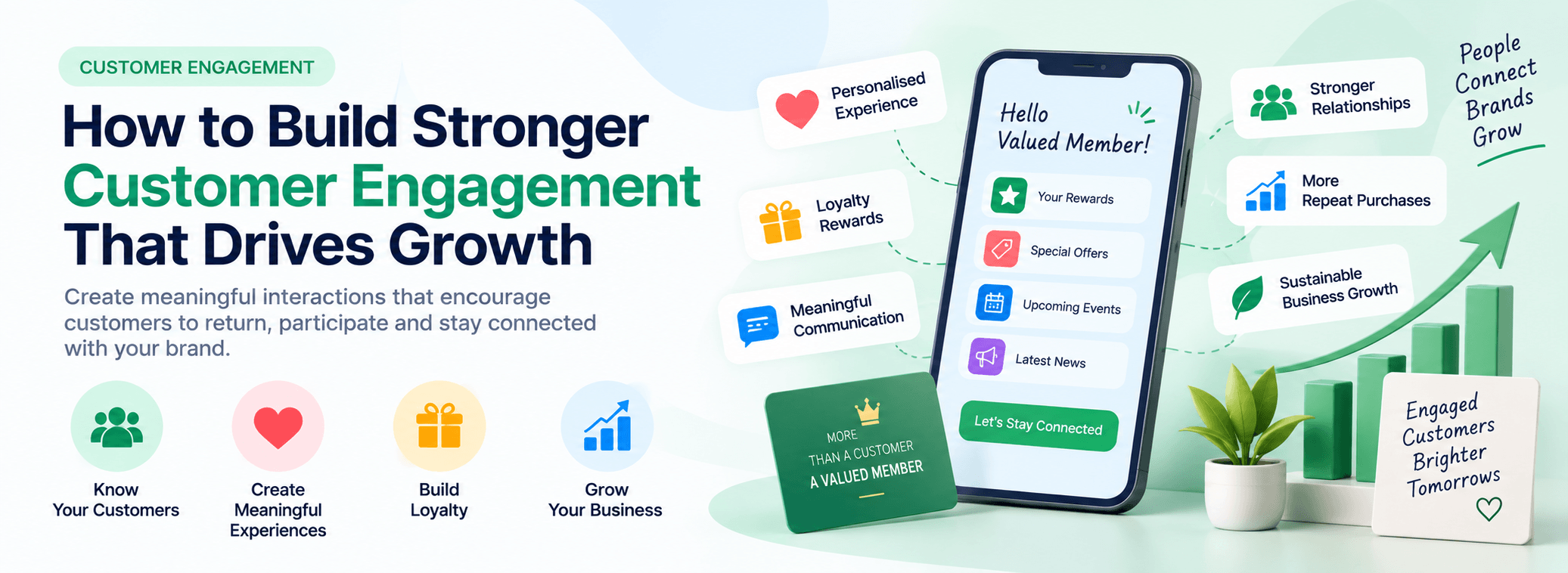
In today's competitive marketplace, attracting customers is only part of the challenge. Businesses also need to build meaningful relationships that encourage customers to return, interact and remain connected with the brand.
Customer engagement is about creating valuable interactions throughout the customer journey. From personalised offers and loyalty rewards to timely messages and excellent service, every interaction can influence how customers feel about your business.
When customers feel recognised and valued, they are more likely to continue engaging with your business and become loyal customers over time.
Engagement is more than communication.
The goal is to create meaningful interactions that give customers a reason to stay connected with your business.
What Is Customer Engagement?
Customer engagement is the ongoing interaction between your business and your customers across different touchpoints.
It includes every experience a customer has with your brand, from in-store visits and online purchases to emails, messages, social media and loyalty program activities.
Effective customer engagement is not simply about sending more messages. It is about delivering the right experience at the right time and giving customers something valuable in return.
- Relevant promotions and offers
- Personalised recommendations
- Loyalty rewards and benefits
- Useful customer communication
- Responsive customer service
- Interactive campaigns and activities
Why Customer Engagement Matters
Customers have more choices than ever. A business that only focuses on acquiring new customers may find it increasingly difficult to build sustainable growth.
Strong customer engagement helps businesses maintain relationships after the first purchase and encourages customers to continue interacting with the brand.
Higher Customer Retention
Meaningful interactions give customers more reasons to return and continue purchasing.
Increased Customer Value
Engaged customers may purchase more frequently and discover additional products or services.
Stronger Brand Advocacy
Customers who have positive experiences are more likely to recommend your business.
Long-Term Business Growth
Better engagement can help create stronger and more sustainable customer relationships.
1. Know Your Customers
Strong engagement starts with understanding who your customers are and what they need.
Customer information can help businesses understand purchasing behaviour, preferences, visit frequency and engagement patterns.
Instead of treating every customer in exactly the same way, businesses can use customer insights to create more relevant experiences.
- Purchase history
- Purchase frequency
- Customer preferences
- Membership tier
- Recent activity
- Reward preferences
2. Personalise Your Customer Experience
Customers are more likely to respond when a message or offer is relevant to them.
Personalisation can be as simple as recommending a product based on previous purchases or providing a special offer based on a customer's behaviour.
Examples of Personalisation
- Recommend products based on purchase history
- Send personalised birthday rewards
- Offer rewards based on customer activity
- Provide targeted promotions
- Recognise high-value customers
3. Create Relevant Loyalty Rewards
Loyalty programs can give customers an additional reason to continue engaging with your business.
However, rewards should be relevant and valuable to the customers you want to retain. A reward that customers do not find useful is unlikely to encourage future purchases.
Businesses can use different reward mechanisms such as:
- Points and stamps
- Cash vouchers
- Discount vouchers
- Birthday rewards
- Tier-based benefits
- Exclusive member offers
- Prepaid rewards and bonuses
4. Engage Customers at the Right Time
Timing plays an important role in customer engagement. Sending the right message at the wrong time can make even a good campaign ineffective.
Businesses can use customer activity to determine when an interaction may be most relevant.
After a Purchase
Thank customers, provide useful information or encourage their next visit.
Before a Customer Becomes Inactive
Encourage customers to return before their activity declines.
During Special Occasions
Use birthdays, anniversaries and special events to create personalised engagement.
When Customers Are Highly Engaged
Recognise active customers with additional rewards or exclusive benefits.
5. Use Different Communication Channels
Customers interact with businesses through different channels. Limiting engagement to a single channel may prevent businesses from reaching customers effectively.
Depending on your customers and business model, you can combine channels such as:
- Mobile applications
- SMS
- WhatsApp or messaging platforms
- Social media
- In-store communication
The objective is not to communicate everywhere. Instead, choose channels where your customers are most likely to respond.
6. Make Engagement Interactive
Customer engagement becomes more interesting when customers can actively participate rather than simply receive promotional messages.
Businesses can introduce interactive activities such as:
Games & Lucky Draws
Give customers opportunities to participate and earn rewards.
Referral Programs
Encourage existing customers to introduce friends and family to your business.
Customer Reviews
Encourage customers to share feedback and experiences with your business.
Exclusive Campaigns
Create campaigns that encourage members to actively participate.
7. Measure Engagement and Improve
Customer engagement should be measured continuously. Without measurement, it is difficult to know which campaigns and strategies are actually working.
Businesses can track different indicators to understand customer engagement, including:
- Customer retention rate
- Repeat purchase rate
- Campaign participation
- Reward redemption
- Customer activity
- Referral activity
- Customer lifetime value
These insights can then be used to fine-tune campaigns, rewards and communication strategies.
Build a Continuous Customer Engagement Cycle
Strong customer engagement is not a one-time campaign. It should become a continuous process where businesses learn from customers and use those insights to create better experiences.
Understand your customers
Create meaningful interactions
Encourage customers to return
Build long-term customer value
From Customer Engagement to Business Growth
Customer engagement should ultimately contribute to business growth. When customers remain engaged, they have more opportunities to return, purchase again and develop a stronger relationship with the brand.
A well-designed engagement strategy can connect several important areas of the business:
Customer Insights help you understand what customers want.
Personalisation helps you deliver more relevant experiences.
Loyalty Rewards give customers reasons to return.
Targeted Engagement helps turn customer relationships into long-term business value.
Conclusion
Building stronger customer engagement is not about sending more promotions or communicating with customers more frequently. It is about understanding customers and creating meaningful interactions that provide real value.
By combining customer insights, personalised experiences, loyalty rewards, timely communication and continuous measurement, businesses can create stronger relationships with their customers.
When customers feel understood, valued and connected, they have more reasons to come back — and stronger customer relationships can become a powerful driver of long-term business growth.
Turn Customer Insights Into Growth
Augmigo helps businesses understand their customers, engage the right audience and build smarter customer growth strategies.
Talk to Us